Showing posts with label James Moss. Show all posts

Saturday, 8 January 2011

Evaluation Question 3 - What have you learned from your audience feedback? (Part 3)


Evaluation Question 3 - What have you learned from your audience feedback? (Part 2)


Evaluation Question 3 - What have you learned from Audience Feedback? (Part 1)

Once the filming process was at its final phase, the group decided to edit the raw footage we had all in one day and display our short to a selected group of people (whether that be family, friends etc). In some of the most primitive stages of this coursework, we constructed a brief questionnaire on what our target audience would expect from a short psychological/thriller, which really helped us conceive a firmer understanding of the requirements we needed to fulfil when creating our short. This evaluation therefore serves an extremely similar purpose, whereby we let selected people fill in the questionnaire, so if ever faced with a similar task, we can continuously better ourselves through constructive, beneficial feedback.

Questionnaire
1)      Gender
2)      Age
3)      Did you understand the shorts presented themes?
4)      Did the short keep you interested throughout?
5)      Would our short influence you to watch others in the future?
6)      How did the short compare to professional pieces of media?
7)      Did the selected soundtrack keep you enticed throughout?
8)      Was the short aesthetically pleasing?
9)      Was the shorts storyline hard to follow?
10)   Would you recommend “Existence of Christian” to friends of your age?


The predominant notion of the questionnaire was to address 21 untrained friends, family and students, so they can express their thoughts upon the “Existence of Christian”. This way, we will be able to confront a demographic that is over Taylor’s BBFC rating, full of people that have to decide with their instincts opposed to a trained eye.  As a whole, we may perhaps be able to grasp different dimensions of positives and negatives that we would usually have dismissed.
For results scroll up.


Tuesday, 28 December 2010

Fourth Day of Shooting

On the 18th of December 2010, the group commenced what we assumed would be our closing day of shooting. With an almost jaded layer of clouds consuming the days sky we packed up the cameras and headed swiftly off to my house to construct some lingering shots from our storyboard. Although the day seemed relatively structured, ideas and positive energy did veer-off somewhat frenetically at points, resulting in fresh and innovative shots that were conjured up on the spot.
At around 9:30am, the group began to set up what would be the first shot of the day. As Dave had previously stated, we had to adapt and tweak the meeting shots in order to mould the plotline in its new direction. Therefore, we had to re-erect the living room environment into a make-shift patient living room, without breaking the invisible wall of cinema whereby props had moved such as glasses or picture frames etc.  Secondly we had to devise some more lines of dialogue, a process that unfolded as a more taxing task than initially expected.
So with that particular shot executed, we began to consider a succeeding shot that Dave Waters had impulsively conjured up. The idea was that following the previous line of shooting- “close your eyes”, Dave Huxford our actor would comply, and sprawl back in his chair (complemented by some clever editing). We decided that the footage would be more profound in the form of a point-of-view shot, and therefore performed several attempts, until Dave Waters executed the perfect shot when knocking the back of his head on my sofa, grounding the film to a very stripped down and raw portrayal of what would happen if a patient was induced into a catatonic sleep.
At around 12:00 we decided to chronologically follow the order of events in the film, thereby we pondered over how we could execute a shot whereby comatose David Huxford is being dragged up the stairs to his demise by crazed psychiatrist George Austin. We decided on a low angle shot in order to portray George’s dominance over his patient, as well as to visually display from a very raw angle the struggle George has to endure to lug a comatose body up a flight of stairs.
The chief problem we encountered in the process of shooting this particular scene was the surface on which we executed the shot. We discovered after several shots that the momentum needed to tilt the camera was simultaneously moving the tripod; therefore I had to sacrifice all dignity by lowering myself beneath the tripod legs and keeping the camera steady in order for the tilt to stay smooth.
At this point the process of shots had been incredibly successful. Therefore we decided to push our luck and head back to a scene at the films progression. We needed to capture a shot of the psychiatrist walking to the patient’s house; therefore we pulled down the legs off the tripod once again and executed another low-angle shot of George walking down the driveway.
It was at this point that it started to spit with rain, a factor that could have easily ruined the shorts continuity. However, the environmental shots secured previously could have easily turned to rain later on in the day, so we thereby decided to preserve the footage to reflect a real gritty, cold sensation- an idea conveyed in a variety of English independent shorts and feature length films.  
The next shots we decided to capture would almost be the linchpin to our short psychological/thriller- the framed suicide letter shots. The most taxing part once again was devising a short, dynamic yet meaningful line that summarised the film without sounding cliché. The dubbed suicide letter would have its origins shot at my bedroom table, lit by a solitary lamp as George forges the patient’s handwriting. This stirred up a variety of problems, the first being that the copy itself was not always central when he wrote it, and secondly, when being scrutinised by the camera and group, the pressure at times veered him into slipping, or mistaking specific word orderings etc.
Its second appearance would appear pinned to the bathroom door and George swiftly leaves the room, implying that the patient has met his demise.  This would be our last shot of the day, whereby George swings open the door, shuts it, and departs with the words pinned to the door- “life is precious, but not for me”.  Despite the fact this should appeared to be quite taxing with many trials and tribulations that could ruin it, the shot was executed smoothly in roughly 3 takes. The door itself didn’t bounce back once, and George managed to open the door just enough without revealing too much.
So completely spurred on with confidence and promise, the group headed back to school, handed the tapes over to Dave, with the upmost self-reliance that he would be able to edit the short by the New Year. Using Facebook as a means of communication Dave unfortunately had to inform us that there was simply not enough footage, unless we were willing to compromise with some less than admired shots. Therefore, within the last three days we are allowed to spend together, we plan on finishing the blogs over Christmas, filming roughly fifty seconds of footage, editing said footage in the evening, thus completely the A2 Media Coursework.

Wednesday, 22 December 2010

Ancillary Task- Unique Selling Point

Once breaking up from school, I decided to take a day out of my holiday to contemplate over the unique-selling-point of our final five minute product-“The Existence of Christian”.

Along with its blemishes and imperfections, I found it relatively difficult to focus all my energies towards one element which would independently sell our short. Therefore, I delved all the way back to the Intended Audience profiles Taylor and I devised. It was here that I embedded myself into Kate’s and Michael’s psyche and questioned what elements of our short would most likely appeal to someone of their age and livelihood.
Though both Kate and Michael vary in age and tendencies, there are very few correlations but correlations nonetheless that formulate some target for a USP. Both have experienced some form of university education, and while one has paid it off, they are still only earning modest money, yet to reach their peak in terms of occupation.
Furthermore, they both seem to revel in independent films alongside glossy Hollywood Blockbusters. Therefore it would appear they appreciate a more concentrated, intricate and at times gritty filmic experience, tackling relevant issues in today’s society.
Now that I have accumulated these character traits, I have carefully reflected over the course of our short, the intricate filming details, the institution who plans on exhibiting it, and will hopefully be able to conceive a perfectly fitting unique selling point that appeals to both model male and female.
It would appear then, that amid the actual filming, the most pivotal factor towards selling the film lies in the institution who shall distribute it- “Openfilm”. Being that it is an online platform for filmmakers, budding artists such as Michael should be aware of the sites existence and should therefore stumble across the film on the proverbial internet surf. While on the other hand, the site is equally user friendly to the likes of Kate Lowlands, who frequently uses the internet for films when the television has nothing to offer. Another unique selling point entwining with Openfilm is the meagre fact that the films are simply free, which one again should entice an audience in the thick of a recession, especially those paying off substantial university fees such as Kate.

When considering interests and the overall intellectually demanding demographic we have obtained, I genuinely believe one of the most unique selling points of our short lies in the subliminal messaging and undertones we have tried to convey throughout our short. Such themes would include madness, abuse, the value of life and inevitably death. As someone who would one day like to go to university and hopefully belong within this demographic, I have a thriving interesting for unearthing subliminal messages within a film, especially the more encrypted ones- a trait I’m sure someone like Kate or Michael would surely have developed.

To summarise the unique selling point in a nutshell, it would go along the lines of- A short psychological thriller, executed through a sparse budget, for people with a sparse budget, while still offering intellectually stimulating footage that mirrors our demographic.

Tuesday, 21 December 2010

Ancillary Task- Analysis of The Psychological/Thriller Posters

Before devising a concrete poster of our own, the group decided draw together some influences in order to improve fundamental standards. Therefore, we delved into the realms of the psychological/thriller film, extracted our favourite posters and wrote up a brief analysis on each. Hopefully in the near future when we decide on a definite poster, we shall be able to incorporate all of the ideas below, resulting in a poster that is truly reflective of our five minute short, and the genre as a whole.
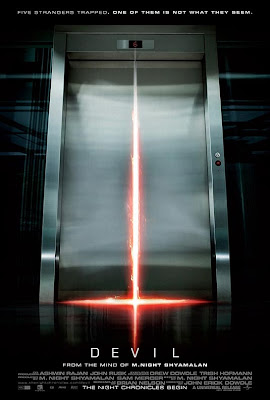

When deliberating as to what posters I should analyse within the confines of the psychological/thriller genre, I decided to delve straight away into M. Night Shyamalan’s 2010 production dubbed “Devil”. Watching the picture in September I can happily reserve judgement on the films quality, while essentially focusing the films chief ideas, and how these notions are reflected through their posters.
On a mere, one dimensional basis, what I picked up from this filmic experience was the notion that evil can quite simply lurk in all of us, whether that lies at work, with family, friends, or in this case, a geriatric.

In this case, I truly feel the poster anchors this central notion quite reflectively. The cold, frantically oozing red light instantaneously suggests danger on the most fundamental level. When analysed further, the red light clasping around the crevice is shaped in the form of the cross, which is thereby symbolic of Jesus’ death, and grounds the film in terms of religious wrong-doing.

The fact that the doors are shut was the most prominent reasoning behind choosing this poster however. From what I have written about above the overwhelming theme of evil is present within the lift. This should thereby disturb the audience’s psyche somewhat, initially leaving them to question who or what lies behind the door. When watching the film, I feel that the posters low key lighting even manages to capture the bleakness in each of the films characters, from the rip-off merchant, to the volatile security guard.

It is important to notice that within the psychological/thriller genre, all their posters seem to adopt incredibly short and dynamic taglines. This stems all the way back to films such as Alfred Hitchcock’s Psycho (1960) - "Check in. Relax. Take a shower” in order to shift the focus on the lift, which is the films pivotal instrument, as well as leaving the audience somewhat cut-off, in a way which they will yearn for more.

It would seem then that the overall impression behind posters such as Devil is to leave audiences with an incredibly blunt snippet of what could be an incredibly complex, elaborate film-in order to leave audiences feeling cold and emotionally detached from the world outside the film.


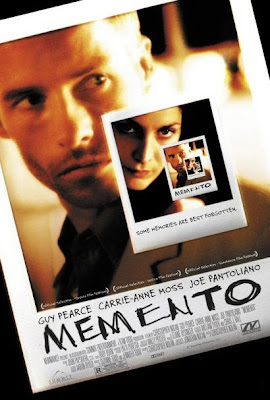
For my second psychological thriller film poster I decided to analyse Christopher Nolan’s narrative warping classic Memento. Written and directed in 2000, the film centres on Leonard Shelby, a man with anterograde amnesia who is unable to render new memories, yet completely driven to lay a path of vengeance towards the man who raped and murdered his wife.

What initially struck me as somewhat interesting was the use of Polaroid photographs to formulate the poster. Once watching the film, the audience are aware that the life that Leonard Shelby once lived has now faded into the past, so to some extent, the pictures should almost strike the audience as a singular frozen moment in time, something Leonard, nor the audience should never forget.

While remembering something such as a photo may not entice the audience, it is also important to analyse the copy-“MEMENTO”. The writing itself is incredibly rugged and almost embedded into the photo quite forcefully. This should accumulate pre-conceived notions in the audiences’ minds of an incredibly frenetic, impulsive anger, and when coupled up with the incredibly tense NVC (non-verbal-communication) that this concentrated moment in time will involve some type of sickening vendetta.

Once again, the poster adopts a snappy dynamic tagline dubbed- “some memories are best forgotten”. This sense of ambiguity should raise questions in the audiences mind concerning these memories, and what the future should hold for these two people within the shots.
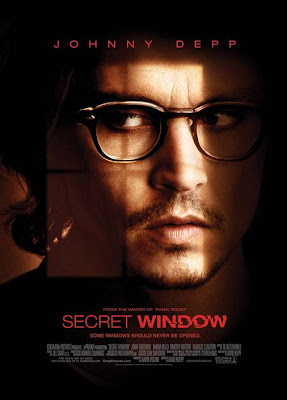

Similar to the two films above, Secret Window is a 2004 psychological thriller film directed by David Koepp.

Similar to Devil, the posters copy is flourished in a very sickening, oozing red. What struck me was how the typeface for “window” is almost smudged and disfigured, which should instantly evoke audience reaction, as something in this poster is evidently blemished, which in some sense anchors the films plotline.

This generic uneasiness and danger is furthermore anchored through Johnny Depp’s NVC. This is reinforced by the fact that the shot is a close-up, which should emphasise some sense of claustrophobia or paranoia. I think it is also incredibly interesting how the window pane almost breaks his face into quarters, which could connote a sense of a dual personality, which is truly reflective of the films narrative plot.

As a whole, I would conclude by stating that this psychological thriller poster has been incredibly ingenious, in the sense that it unfolds a lot about the plots narrative course while simultaneously concealing anything too important. For instance, Depp looks neither volatile nor vulnerable, yet the red danger-connoting slewed copy would simply suggest that he is unstable. The fact he is partially concealed behind a jaded shadow could propose that he is hiding as a victim, or a felon. If this psychological/thriller captures anything in the audiences mind, it would be an overwhelming sense of ambiguity and unease, a suitable catalyst for any passionate thriller fan.

Wednesday, 1 December 2010

2nd Day Shooting Dilemma


With the countryside footage fundamentally secured the group began to ponder over a day in which we could shoot the psychiatrist sequence. With the first and foremost priority concerning if our time-table frees interlocked, we settled on the 30th of November- a Wednesday. This would essentially serve as enough time to lock down the psychiatrist footage, with just one more day left to execute the bathroom sequence (and remaining shots).

With this arrangement set firmly in the groups minds we set off to prepare for the days shooting. With Dave devising some last minute script notions we even began to reconsider re-drafting the script for the day ahead. However, a day prior to the shooting process the BBC Weather Forecast looked somewhat daunting. Reports had been formulated stating Heavy snow and light rain showers for the night.

If the forecast was accurate to any extent, the days planning would have to be abolished. This fundamentally derived down to a series of reasons, the most predominant being the fact that if the snow was as relentless as predicted, the team wouldn’t be able to congregate at all. Secondly, the shots captured in the sequence prior were merely somewhat foggy; therefore the conflicting mise-en-scene would be extremely noticeable.

As a result, we have been left with no other choice but to shoot another day when the snow has cleared- perhaps the Friday of the week. However, one lesson to take from this unfortunate circumstance is that we need to scheme these days more thoroughly, insuring the weather will match the cinematic frameworks, and preferably earlier in the year, with more time to spare.

Tuesday, 30 November 2010

Setting and Location Ideas: Psychiatrist Office

With the shooting schedule date imminent, the group began to frantically seek out a psychiatrist office. The notion was to locate a room that reflected the grey and jaded mise-en-scene from the countryside shooting, whilst maintaining some sense of a clinical, uncomfortable atmosphere.

Keeping that in mind, we all set out searching yet to no avail. It seemed that no matter where we looked it because almost unattainable to locate a room that would enhance all the ideas and notions we were trying to arise during our short thriller.

It was only when flittering through family pictures when I stumbled across photos of our recently refurbished living room. As one could formulate from the pictures below, the proverbial film fan could argue that such a setting would destroy the clinical notion set above. However, the group have reassessed this idea, and determined that perhaps the family setting could work just as effectively.

This could reinforce the suggestion that these are just normal people, with completely juxtaposed views upon how they live their lives. It would also anchor the violent, more climatic scenes towards the films conclusion, as it would ground the film and make the scenes unfolding before the audience seem more authentic.

Some of the problems we may encounter however derive back down to the fact that the room is a living room- not a psychiatrist office. However, like all good directors of their art, we can hopefully mould this around the plotline. For example, protagonist Christian is a volatile yet intellectually stimulated being, who has almost lost faith in the world and the people around him. So when he is forcefully subjected to see a phoney psychiatrist, trying to conform to a world gone wrong by preaching from the confines of his own phoney living room, this would infuriate the protagonist, ultimately leading to the psychiatrist’s demise.

Obviously, we could manipulate the space we have, to reflect the psychological/thriller genre. Such examples would include removing the rugs, sofa and family pictures. We could even pull the blinds and dim the lights to formulate an almost surreal, dreamlike sequence. One group member even suggested lighting the fire, which co-links with such films as “Shutter Island” in the warden office. As the room is quite drawn out as well, I can picture that reinforced long shots of the two over the table would anchor the scene quite fittingly.

Like with all initial ideas, I can understand that on the very day of shooting this room may not meet the required standards that our group are longing for. For example the lighting may be wrong, the required camera angles may be inaccessible, the mise-en-scene may conflict with opposing scenes etc. However, hopefully this suggestion will speed up the shooting process and enhance our marks in the long run, balancing on the factor of luck and how the footage looks on camera.

Hopefully if we do chose to pursue this room for this particular sequence, we can draw together a comparative blog-post of the room prior and post shooting dates, to inform the examiner of how we moulded a simple living room into a make-shift psychiatrist office.

Tuesday, 23 November 2010

Character Development & Influence

As the group was practically all set to shoot, we began to deliberate over one of the most vital aspects of our five minute Thriller- the protagonist. We are essentially aware that within the confines of a short film, it is unlikely the audience will form bonds and thereby connect with this persona, so as a direct result, we plan on illustrating a figure with no back-catalogue, which in itself should formulate enigmas, as well as an air of mystery.

After some careful thought, we settled on the name Christian. Portrayed by our groups very own David Huxford, we have selected this name for a handful of reasons- Fundamentally due to the fact it is a conventional English name, which should raise deceiving pre-conceived notions of normality in our audience’s minds. Secondly, our audience should subconsciously link the name to religion, so when they closely analyse his contradictory mode of action, this should formulate some sense of irony- a trait we wanted to encapsulate within our short thriller.

The short as a whole revolves around the themes of trust, grief and the human mind. The name therefore could metaphorically anchor who the lead protagonist yearns to be, despite the fact that his life has moulded into something somewhat demented/ deluded etc.

In terms of his disposition, he is regarded as fairly erratic, and at times volatile. Despite this however, he is an intellectually stimulated human being, someone, who perhaps feels suffocated and crushed by this intense knowledge. This may sound somewhat vague; however, he yearns for that oblivious naivety that the vast majority of people do not seem to appreciate on a day-to-day basis.

The fact that the vast majority of shots selected within the 5 minute sequence will consist of long-shots of the protagonist, we could also argue that his tall/somewhat spindly Non-Verbal-Communication to convey signs of malnutrition. This could be one of the first pre-conceived notions the audience will formulate to suggest that he will inevitably commit suicide, despite the fact that he is the culprit. This should be fairly effective in the sense that Thriller’s are renowned for their enigmas; therefore questions will be raised as to how such a person could commit such a crime.

To anchor Christian’s mediocre, yet seemingly important life, it is vital to consider his place of residence, as it has to reflect his persona in a fitting way. For example, as his psyche is somewhat frenetic, nonetheless demanding, I could imagine his house would be littered with mess, but all the same day-to- day items that would be demanded on the proverbial week. Like his name, I can imagine the street would be extremely reflective, somewhere based in the suburbs, where nothing out of the ordinary would occur. Thereby, the climactic scene of death would be exemplified and magnified simply due to the normality of the house, the normality of the room, yet juxtaposed with a warped mind.

In terms of the Psychiatrist, we required a figure that could perhaps fit within the perceived stereotype of a psychiatrist. Therefore we pursued fellow student Dr. George Austin- your typical male psychiatrist, with the conventional, visual allure to suggest he leads a financially steady life alongside the nuclear family, with little or no troubles. This conformist nature is the exact stereotype that protagonist Christian would internally despise, which is the controlling idea behind our short. This typical stereotype should reflect his dialogue/psyche as well, to the extent where it sounds as if he is treating Christian more like a number opposed to a person, which should eventually lead to his peril.

The influence for this comes from 1960s TV show The Prisoner, in which the main character is only referred to as "Number 6". This spawned the famous quote "I am not a number, I am a free man!" and could be seen as a protest of individualism against a world where to be seen as different is bad. An underlying theme of our character will show elements of this, as part of the reason he is seeing a psychiatrist could be because he feels outcast.

Another film which has influenced us is 2001: A Space Oddyssey. Although not a 'character' in the traditional sense, HAL 9000 is a rather scary vision of how computers may one day be the downfall of mankind. The reason it is influential to our film is that, much like HAL, our psychiatrist seems to be there to help his patient and would never harm him. However, it turns out that he has a sinister dark side. In the case of HAL, this means sacrificing the crew for the good of the mission. In the case of the psychiatrist, it is not clear what his motive is, however the idea is much the same; and made even creepier by the juxtoposition of his psychotic motive against his calm, boring voice.

Monday, 22 November 2010

Script-First Draft

Psychiatrist: So let’s progress. Within this world, within the confines of your own existence, explain your troubles. What bothers you?

Patient: Hmm… I dunno’. Every morning, I get up, and I think what am I doing here? What am I feeling? What am I giving?

Psychiatrist: You see (name), it doesn’t matter what path you’ve gone down, or where you plan to go. You just need to find some hope in this world.

Patient: Hopes just a word, and you can’t just find it at work, or with the family, or in some dream. And sometimes you just think, damn, have I really got to live like that?

Psychiatrist: Well now, that’s why I’m here, together we can beat this.

Patient: Are we done?
- - - - - - - - - - - - - - - - - - - - - - - - - - - - - - - - - - - - - -

Patient: Now listen, I may be wrong, but this hope you speak of. It lies in the air we breathe, the sounds we hear, and the water we lay in…

- - - - - - - - - - - - - - - - - - - - - - - - - - - - - - - - - - - - - -


Script Inspiration- "Last Thoughts on Woody Guthrie"

The inspiration and influences for the script above derive from a recital, performed on the 12th April 1963 by American Singer-Songwriter Bob Dylan.

The reason I have moulded the script around this renowned piece of poetry is due to the context of poem. Dylan uses this five page stream of consciousness to singlehandedly convey all paths we can pursue in life, from a youthful mad delirium, to old age, and unavoidable death.

Through this collective piece of writing however, the piece manages to entice the reader to realise how we function in this world. We all have no recollection or reason as to why we are here, and our lives, and inevitable death is subjective to the people around you. For instance, Woody Guthrie, died in a hospital, yet Dylan summarises the poem with- “And though it's only my opinion, I may be right or wrong, you'll find them both in the Grand Canyon, at sundown”.

Therefore this poem reflectively conveys all walks of life, whether that is misery, or happiness. This is the sole reasoning behind using this piece as influence, as both the patient and psychiatrist are two people of conflicting personas, who hold fixed ideologies upon life, a theme consistently regurgitated throughout Last Thoughts on Woody Guthrie.

Monday, 15 November 2010

Hypothesis for Questionnaire

For our questionnaire the group decided that it needed to be specific and bold if it was going to be any real use to us. We decided to build up a hypothesis of precisely what people we would ask. People outside of media studies don’t tend to watch short films, as they are hard to access and don’t have a large demographic to aim at. Because of this we decided to ask people outside of media studies so that we could gain an insight into what casual film watchers would look for or would interest them if short films were more easily available. By finding this out, it would also allow us to market our film better to casual film viewers outside of media and film production with posters and magazine reviews that have to be completed in the ancillary tasks.


From the answers we got it is clear to see that the majority of people would not watch a short film out of choice. If they did watch one, they would prefer to watch it in a cinema before the feature film. The most likely reason for this is that it wouldn’t require any extra effort from the viewer as they are already at the cinema, and also the film would likely be the same genre as the feature film. Most would also be willing to watch a short film on YouTube rather than TV, for example.

Of the thriller sub genres, it would seem that people would rather watch a psychological thriller than a horror. Perhaps this is due to the fact that the Horror genre has been worn-out to the extent where these thriller hybrids are becoming somewhat cliché and thereby dull. Therefore, one could argue that the more contemporary thriller enthusiast likes how the human mind works, incorporated within a narrative full of enigmas and twists.

However, from our questionnaire, we also formulated data which suggested that the conventional thriller fan prefers realist narratives opposed to surrealism. This would suggest that although perhaps the simplicity of the horror/thriller may be a dying breed, audiences still enjoy a simple narrative that can keep them engaged, yet perhaps with a twist that will not disrupt the flow of the narrative.

Overall, when looking back upon the early hypothesis devised by Taylor Gladwin, the questionnaire closely reflects his notions above (with some slight variations).However, from this piece of data collection, we can now modify our marketing strategies, and perhaps showcase our short before a feature film of the same genre. The audience would therefore feel inclined to watch our short as it would bear little or no effort to watch. We can also back-track to our storyboard, and slightly tweak the narrative to meet our demographic requirements.

Friday, 12 November 2010

Planning Diary

Week 1

As the group fundamentally comprises of two As Media groups, we shall initiate the coursework by analytically comparing our prior media blogs, so we can accumulate notions upon where we went wrong, and where we thrived, to ultimately build a blog embracing both positive ideologies.

Once this has been polished off, we will begin to devise ideas and notions upon our five minute production. Here, we will post initial, preliminary perceptions upon our film, which should thereby reflect an intended audience. Building up our blog step by step, we can use our findings above as a catalyst to formulate ideas upon our intended audience institution- an in-depth post concerning how and when we can exhibit our short production. Finally, we have to eventually consider accumulating research for themes we plan to exemplify, as well as codes and conventions for the near future.

Week 2

While week 1 served more time towards preliminary research, with posts not always relating to our short production, week 2 will more intimately reflect our progress and ideas upon our short. For example, posts will be conjured up concerning our strengths, weaknesses, opportunities, threats, mood/ story boards and risk assessments. Moreover, we may develop our common understanding of the short though the odd textual analysis.

Another key feature to blogging we plan to complete soon will concern a protagonist analysis post, methodically explaining our characters name, origins, disposition, role within the film, and how his worldly present reflects the genre of the film.

To wrap up the week, we may very well devise an intended audience profile, for both the model male and female. However, the board has stressed the importance of this post, so we may just reserve our energies for a later date so the post can hit its optimum level.

Week 3

Similar to week 2, the group will essentially focus their energies towards developing their overall idea for the short film of our choice. Once the intended audience profile is complete, we shall pursue our influences within the realms of film and display how these films have reflected our ideas, as well as our primary ideas upon sound, iconography and costume design. Piecing the work together ever so slowly but surely, we will then exploit the use of group member Dave Waters’ car and hopefully go in search of some appropriate settings and locations.

By now, the group will be basically ready to shoot our short production. The duration of shooting will fundamentally depend on weather forecasting in the near future, and whether we score lucky with our setting and location ‘hunt’. However, if all runs smoothly, we could potentially shoot all the mandatory footage by the end of the week, or half-way through week 4.

Week 4

The agenda upon week 4 ultimately depends on the fate of our shooting the week prior, however, if the course of action runs as prepared, the group can essentially focus of post-production work, involving evaluations of shooting, sound, mise-en-scene, editing, audience feedback, institutional analysis etc.

Week 5

Complete remaining post-production work, and pursue evaluation questions until completion.

TBC

Thursday, 11 November 2010

Initial Ideas For Title Sequence

After careful deliberation within our group, we decided that a well-filmed title sequence would be an exquisite extract to add to our film. Many of our group’s members favourites films have excellent opening credit sequences, and we all believe that having a good title sequence adds to the films mood and gives the audience an idea of what to expect later on. We also proposed the idea of having a title sequence completely opposite to our film’s mood, to throw audiences off, so that when certain events happened in the film they would become more shocked and surprised. This idea was well thought out at first, but fell through and we decided to create a simpler title sequence, but with interesting and provocative images behind the credits.

We took influence from the opening sequence of ‘This Is England’ (Dir. Shane Meadows, 2006). Though not in the same genre as our film, the opening credit sequence intrigued us a lot. The images are all of England itself, starting off with happy images, but slowly drifting to ones of misery and despair. We thought that this technique was very effective, and thought that we could use a similar method for our opening sequence, to show our protagonists psyche and his view upon the outside world. Rather than using images of England, we thought we could get images of particular places. For example, for the opening shots which will be ‘happier’, we could get shots of trees in autumn and children playing in the park. As the shots get darker and more distressing, we would use shots of dismantled houses and shoddy wastelands. We agreed that this sequence would set the tone for our short film and give audiences an idea of what to expect from the next five minutes of footage.

Another title sequence that our group took influence from is from the film ‘Alien’ (Dir. Ridley Scott, 1979). The opening sequence was very minimalist non-diegetic sound, and the word ‘alien’ slowly comes together on the screen. As the letters piece together, the suspense gets cranked up and as the word is finally complete, the viewer is shown the spaceship on which the later destruction will happen. This opening sequence was very influential on our group, and we especially liked the use of minimalist sound. We agree that a particular song or a lot of non-diegetic sound over the images in the credits would not set the mood as we would like, and we would most likely not get the desired reaction from the audience to the images being shown. Because of this, we have agreed that the least amount of non-diegetic sound would be the best way to open the film and set the mood.


Dr. Strangelove

Although classed as an old gem in cinema history, Dr. Strangelove was one of the first of its kind to employ a title sequence at the beginning of a film. What I have learnt from this preliminary research is that it must reflect the genre at hand, a trait Dr. Strangelove captures perfectly, as a B-52 bomber “mounts” a KC-135 Tanker in mid-flight.
The remaining reasons I have pursued this film as inspiration for our title sequence concerns it overwhelming simplicity, yet maintaining dynamic impact all the same. So although we may not necessarily incorporate planes within our opening sequence, soaring through the air, we plan on capturing this simplicity in a way that anchors and reflects our psychological thriller genre. In terms of sound, the contrapuntal, American alteristic non- diegetic sound serves as an effective anchorage for the upcoming film, as this could satire the stupidity of war, and the fact it is ever going and omnipresent.


Watchmen

Watchman, on the other hand, presents a new, jaded world. This is fundamentally captured through the cinematic frameworks, that being mise-en-scene, editing, cinematography and sound. The title sequence suggests how life has fallen through new tangents, which has thereby altered society’s minds and perception upon the world. As a result, this universally affects the psyche, something that co-links with our films genre. The sequence fundamentally presents the beauty and malevolence in life all wrapped into- the torn disposition of our protagonist.

This theme entwines with the over-dubbed non-diegetic sound of Bob Dylan’s The Times Are-A Changing, a song which lyrically mirrors how people are progressing too fast for the world, which will inevitably lead to its downfall. This similarly anchors our protagonist’s psyche, someone who cannot keep up with the world’s progress, and therefore slips between the cracks of life.

In this sense, the opening sequence should serve as some form of metaphor for the lead protagonist; so therefore, it should mirror the genre, our patient and the world within our film.

The only chink in the armour here concerns the complexity of Watchmen’s opening title sequence, rife with special effects and CIG. It appears however that dynamic impact can also be presented through simplicity, as seen in Dr. Strangelove. Therefore, we will have to entwine features from both film’s title sequences.

Tuesday, 9 November 2010

Initial Ideas on Cinematography

Whilst simultaneously crafting our story-board, we split the group and began to formulate ideas for specific shots that could reflect our short five minute Psychological/Thriller.

Being that the genre relates to the psyche, or processes of the mind; we have appreciated the fundamental needs of (extreme) close-ups, to anchor claustrophobia and paranoia encapsulated within the protagonist. Secondly, we will need to consider the leading figures temperament when confronted by interaction.

Due to the fact he is essentially a solitary being, we will have to stay away from two-shots, instead maybe reverting to shot-reverse-shot in sparse moments of dialogue. This friendless notion that we have pinned upon the protagonist could also be anchored through wide shots of the countryside, with the figure lonely traipsing through fields, a shot inspired by “The Quintessential Guide To Dispose a Body”.

As time is of the essence, it would seem irrelevant and lengthy to discuss every shot throughout our five minute production. Therefore I plan to discuss our finest ideas concerning iconography, our first being the establishing shot of a bathroom plug-socket. We have pondered as to following the socket wire up to a perished corpse limp inside a bath. Initially the execution of such shot may be regarded as somewhat taxing, as we will have to locate a tracking dolly, and perform an extremely smooth shot. Straight away from this very unsettling image the audience shall hopefully be able to identify the genre, as the gingerly prowling cinematography should almost mirror a stalking notion, perhaps somebody who is so dehumanised, they have taken on animalistic like qualities.

Though spoken of before through initial research, we have also discussed the suggestion of a dolly shot tilted down upon the countryside. Coupled together with some thought provoking non-diegetic sound, this shot could symbolically propose that life is at times one big congealed, rushed mess. However, the beauty encapsulated in the shot could subconsciously portray that despite this notion above; the beauty in this world is what makes life worth living- the two conflicting dispositions that tear our protagonists mind, encouraging him to react as he does.

The next shot, influenced and inspired by “Garden State” ”, we plan on using an over-the-shoulder shot, reflecting off a mirror to identify our protagonist for the first time (commonly referred to as a Master Shot). This shot, introduced by a possible tilt up from the sink water could once again anchor the paranoia encapsulated within the protagonist’s psyche, as his suspicious, fearful state encourages his mind to believe the world is out to get him. This should thereby throw the target audience off course, as they believe this homicidal lunatic is actually the victim.

In terms of props and iconography, we almost want to capture these material items in a similar way to the countryside dolly shot. Initially this may seem vague; however, being that the protagonists yearns and almost dreams for a better life, he consumes his life around materialistic comforts, opposed to continually bettering himself as a person. Therefore, all shots of his clothes, clocks, radio and television perhaps will be executed in a close up, as he in not extracting the bigger picture out of life, which could be offered perhaps through a long/mid shot.

Tuesday, 2 November 2010

Initial Ideas for Sound

Once the crucial ideas for our short production were laid out on the table, the group began to consider suitable Iconography, setting, location and sound for the psychological/thriller. Bestowed with the role of sound, I shall base this post purely on the sound I fundamentally envision, in a way that entwines successfully with the cinematic frameworks of mise-en-scene, cinematography and editing. Although some of the diegetic and non diegetic sounds I shall post may contain featured works of renowned artists, I cannot stress enough that we do not plan to use these extracts, moreover, I would like to state that they are merely an illustration of what we plan to use.

Before I delve straight into the realms of sound within our short, I feel it is paramount to consider the protagonist at hand. In any film, from the blockbusters to the independent shorts, it seems essential to base and mould all sound around their disposition. Otherwise, the other factions of cinema clash (unless the sound is contrapuntal).

As the short primarily starts, we plan on using an establishing shot of a perished figure lying in a bath. Here such ghastly horror will be layered with perhaps the non-diegetic sound of a distorted radio, unremorsefully buzzing away through layers of static, while a solitary radio DJ or News/Traffic Reporter mummers in and out of speech. Alongside this, we may toy with the alternate tangent of absolute silence as the camera gingerly pans over the wire. Both create a sense of atmospheric allure, something which instantaneously arises questioning/enigmas.

Following this scene, the audience are finally acquainted with the protagonist, a mystifying figure shaving in front of a mirror. Here, I feel the audience need to embrace this character as quickly as possible, as his role is paramount to the success of our short. Therefore, any diegetic music would disturb such relationship. Therefore, the audience should be left with an uncomfortable looming silence of the razor gliding across the protagonists face.

Despite the fact that the school cameras are notoriously well known for not detecting diegetic sound, we have been forced through our plotline to offer some form of dialogue to the table. Here, the conversation will be shared hopefully through a cross-cutting shot involving a psychiatrist and the protagonist. Considering that one man is a trained master of his occupation, while the protagonist is a somewhat profound, frenetic, tortured soul, the dialogue should therefore be somewhat philosophical, abstract and at times heated.

In terms of non-diegetic sound, the melodies which are featured throughout the panning shot sequence of the countryside should anchor the undisclosed thoughts that lie within our protagonist psyche, a melodic rhythm or vibe which conveys both a positive and negative form of diction throughout. A song or instrumental deep cut which resembles the sound I would like to capture is that of “Treefingers” by Radiohead or "Straumnes", composed by Icelandic band Sigur Ros . Something resembling this could double up and blend with the mise-en-scene of our protagonist, somebody whom on the outside is screaming for acceptance, while almost everything internal is pulling them away from the mainstream light, coincidentally, everything Radiohead stand for as a band.

Most recently the group have been devising ways of connoting that the protagonist is cracking somehow by the pressures of life. So far, we have conjured up the plan of a clock, ticking in an anti-clockwise fashion. Symbolically this could represent sparse time, impending doom etc. However, opposed to diegetic sound, we want to progressively build this sound, along with other household appliances, perhaps a kettle etc to mirror the building and relentless pressures of life. The reason we have chose non-diegetic over diegetic is simply due to the fact that the sound will be easier to progressively rise through Pinnacle Editing.

Towards the films heated conclusion, we could once again follow variable tangents. The simple use of silence could mimic the solitary, dismal, and lonely life of a misunderstood killer. On the other hand, we could follow the alternate route of the non-diegetic sound of the distorted radio (used in establishing shot) while the protagonist performs his devious misdemeanour. Here the sound will instantaneously cut out-to convey the victim inside the bath has perished, thereby symbolising the end of the film. Finally, we could gradually build the non-diegetic sound, to an almost tribal, animalistic point of murder. Once the deed is done, the non-diegetic sound could rise above the cusp and return back to soothed yet menacing “Treefingers” instrumental, to portray that while the storm has died down, there will always be some lurking pain within the protagonists' life.

Here are some primitive ideas for sound. Some may not exactly work within specific scenes, a common dilemma within the world of shooting and editing. However, I feel that this post at least serves as a starting point within the cinematic framework of Sound. It should therefore be interesting to compare once the editing is complete to see if the sound resembles this post in any particular way.