Showing posts with label David Huxford. Show all posts

Sunday, 9 January 2011

A2 Media Blog - The Journey

For the year thirteen media blog, Mr. Sheriff (head of the media department) said that we should make this year’s blog like a journey. He told us to say how we had evolved from the process from the beginning of the project to the very end. This is to re iterate that journey, and what it has done for our media group.

This whole journey really began at the end of the year 12 media blog, when we had to complete the beginning 2 minutes of a thriller genre film. Back then the media group consisted of David Huxford, Taylor Gladwin, Bradley Hart and Tom Winn. We were initially known as ‘Thumbman Productions back then. This was what we were able to base a lot of this year’s blog stuff on (because we had already done it before). But this year was different, because Brad and Tom Winn wanted to do a music video instead of a short film; me and Taylor partnered ourselves with Dave Waters and James Moss. These two were partnered with Justine Carron and Rachael McClure, and were collectively known as ‘Angry Productions’.

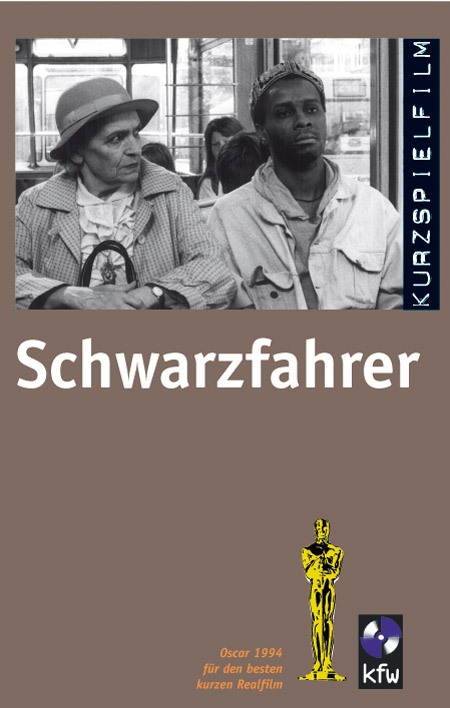
 At the beginning of this task, once we had gotten allot he groups sorted out and everyone was ready to go, we researched a lot of short films with Mr. Marshall. Because unlike last year our short film didn’t have one set genre, we researched many films of different genres. Many of these films include ‘The Black Button’, ‘Doodlebug’ and ‘Schwarzfahrer’ (personally research). On top of this, we watched short films that had been created by last year’s year 13 students.


Because ‘Thumbman Productions’ was the group that gained the best mark in the task last year (with an overall score of 92/100), me and Taylor thought our selves rather lucky to partner ourselves with two students that received A grades in both the exam and the coursework just as we did (after Dave Huxford’s re-sit). But because of the huge success of last year from both Thumbman Productions and Angry Productions, we wanted to beat the group that got the best grade last year for the same task, and that group was the ‘Pete McLaughlin group’. There overall score for both blog and video was 93/100 (and 6 marks had been deducted from the scores before this grade was published). This gave us great motivation to get this blog to be as best as it possibly be. However, it didn’t start out as we had planned.

The first thing we planned to get started on (much like every other group in the year) was the controlling idea of our short film. The idea being that once we had a solid idea of what the film would be based on, the actual ideas of what the film would have in it would evolve with rapid succession. But, we couldn’t think of an idea. We developed many ideas of a good short film that was a good genre; as well have challenging themes so the audience could enjoy the experience even more. But as we continued to think, we couldn’t think of a controlling idea and the longer we thought, the more groups that thought of their controlling idea and got cracking on with storyboarding their final idea. Because we took so long getting our controlling idea, we didn’t get our storyboarded idea completed until the end of October.

Getting started on the blog was also not as simple as we all had originally intended. We had accepted that we had to spend time researching short films and what we were to put on the blog, but because of the time it took to get our idea set in stone, other blogs had gotten up to 10 blog posts, and we had just managed to begin our blog with an introduction. We tried to begin with what we had done last year and how it was going to be the bass of what we plan to do this year. But rather miraculously, we’d managed to get our act together enough to get more blog posts up to catch up with the other groups in the year.

As one blog post turned to ten, and ten turned to many more, we thought our group was in the driver’s seat. Wit a lot of our research done, we still hadn’t completed the main concept of our coursework, the storyboard with our final idea on it. So as we had basically all of our research completed, we spent the remained of our time working on our soon to be completed storyboard. With the storyboard finally completed after a strenuous amount of energy and time doing this task, we had all felt it worth it when w al felt like we had given ourselves a very good idea for a 5 minutes short film, which would give us a really big chance of beating last year’s best blog.

But it was around this point in the task where stress takes over the body, and this lead to many arguments about the blog was being unleashed on the group. The main problem was the fact that some people were getting more blog posts than others, and group members were complaining that they weren’t getting enough, and this would lead them to getting not a good enough grade at the end of this project. These arguments lasted through the media lessons whilst we were planning, but these eventually cooled over and things were back on track to completing this task.

So with the planning done, storyboarding completed and enough blog posts to have a comfortable place in the packing order of the media blogs, we finally got our act together and began shooting. With Dave Waters being the only member of our group able to drive, we relied a lot on him to get us from location to location, and to get some really good shots of the countryside from the car. After getting all of the outdoor shot that we needed done, we went to the locations to which we would film our indoor shots. We had decided our indoor shot quite tentatively as we didn’t want to venture all over the area searching for the perfect bathroom t use, so we used James Moss’ house, because of what it had to offer as well as its prime location right next to the school. After 5 days of filming (spread out over a long period of time) we had gotten enough footage to begin editing our final product. But we came across many distractions whilst filming at James’ house, the biggest being his PlayStation3. With games such as Red Dead Redemption and Fifa 11, sometimes we didn’t do as much filming as we had hoped, and played too much. This hindered the project a lot because we needed to come back other days, days which we could have spent doing something more time efficient and work efficient.


With time running out on us, and everyone else was finishing up their final products, we left the editing up to Dave Waters because he had the same editing software as the school, so when us as a group couldn’t edit the product, he could. With the final week of the project ahead of us as we headed past the Christmas period, we decided to put ourselves into full throttle to get this done before the deadline. But the relentlessness of the project kept pushing our buttons, and the final two days proved to be the biggest push to finish we’d had so far.

As we went to edit the final clips into the final project, we tried to find the country side shots we had filmed on our first day of filming. However, we found the file, but it would open, the file was corrupted. So we needed to film all of the stuff we had before again, and because it was raining outside, the moral of the team was at its all time low. But we had managed to get all that we needed done for that day done; all we needed was the voice recording for the radio scenes. But once again, something had to go wrong again. Somehow we didn’t have the correct software to record what we needed for this final part of the journey. The pressure was especially on at this point because the project was due in the next day, so now wasn’t the time to be making any mistakes or not have what we needed. Eventually, we decided to use my Nokia phone voice recorder to record and upload the recording. To be honest, it worked a lot better on the phone’s voice recorder because it gave the recording the effect that it was actually being played on the radio.

Towards the end after the video had been edited, we needed a trailer to encourage our films success through viral marketing. But due to running out of time, we couldn't make one for our finished product. However, this wasn't a massive blow as all short films don't have trailers. But though it would have been nice to have made one, the process did teach us all to be more time efficient as well as to get things done earlier to make room for things such as the trailer.

But alas, after 4 months of thinking, analysing, processing, filming, blogging, arguing and breathing one heavy sigh of relief, we (as a group) are confident enough to say we are finished the A2 media coursework. But after this whole process, the journey from the beginning to the end has played a key role in this entire project. It has not only allowed us to bond as a team, but also it taught us lessons about how to organise our time better and how to work better as a cohesive unit. However, the few of us that wish to go into a field that requires this kind of ability, we will be able to look back at this journey and say that this was a significant part of what every film, advert and video that we create from here on in. But a small part of us are sad that this project is over, with the ability to leave lesson to go round someone’s house and film to create something that could be your claim to fame is saddening, but once we receive the grade that we hopefully deserve, we’ll know that the journey from sufferers to successes would have been worth it all.

Saturday, 8 January 2011

Evaluation Question 4 - How did you use media technologies in the construction and research, planning and evaluating stages?

This evaluation is very similar to the evaluation question we had to complete in Year 12. Because of this, a post it presentation was the way in which we decided to portray this presentation. The presentation was divided into two categories - TV and Internet, which was spread out over 4 sections: TV as a whole; social network sites; video sites and search engines. This is the final product:

Trailer - Why hasn't one been edited?

Somewhere earlier in the blog (in the viral marketing section), we mentioned that to boost viral marketing for the finished video, we would have a trailer out to alert people of our short film. Unfortunately, due to events that have left me without decent editing software and timing uses, we are not able to create a trailer for the blog.

Due to time, the main editor Dave Waters finished the final product with days to spare, and with the arrival of this final editing task didn’t want to spend more time editing. So, to help him out, I decided to edit the video myself with editing software I thought was able to make a trailer video without any major problems. What Dave Waters used was Pinnacle, an editing software that was there same as the schools (he had a newer version of this software. What I had was software that came free with my Panasonic Camcorder: HD Writer AE 2.0 and I thought this was fine. However, I later found out that not only was what I had almost impossible to get how I had envisioned the trailer to be like, but the final product could be edited on my software. I had to use my camcorder to video the scene I planned on using for the trailer so that it became compatible with the software.

After spending a considerable amount of time making the trailer, I knew that other parts of the blog needed looking at, I decided that the trailer wasn’t going to be made. Even though one would have been nice, short films don’t normally present a trailer for their short film because the films are too short to make a decent trailer from it and also the film itself is a form of advertisement, but more for the director to be recognised. Nonetheless, a trailer has not be edited together.

Tuesday, 4 January 2011

Magazine Article - The Finished Product

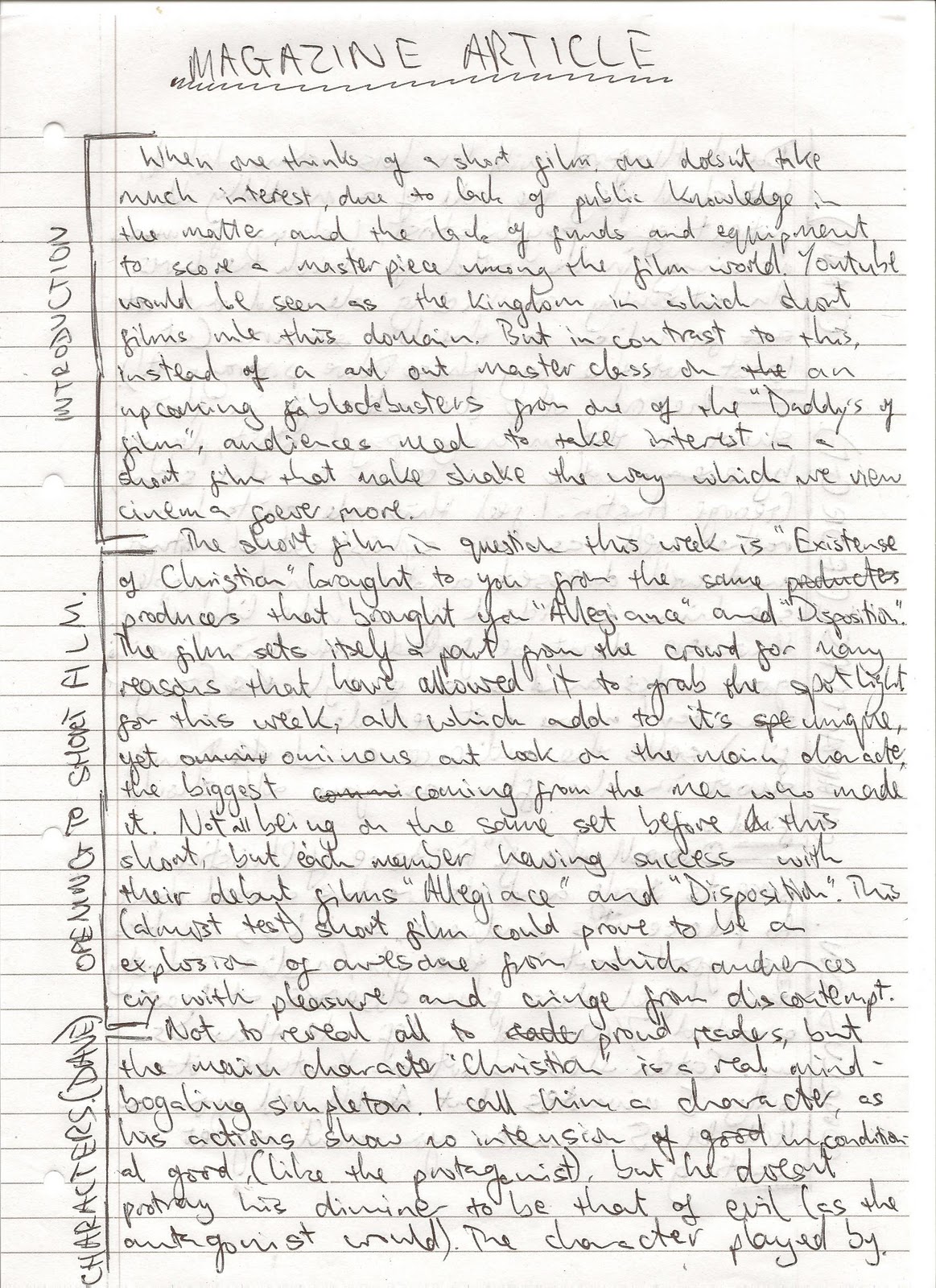
Even though we had settled on a final draft of the magazine review, Dave Huxford and I decided to redraft it one more time. We edited a few sections to make them more readable and then I used photoshop to make it into a realistic looking review from Total Film Magazine:

Ancillary Task: Magazine Article - Final Draft


This is what shall be viewed on the magazine article in the magazine we have chosen to do it in. This version of the ancillary task looked to be the best it could possibly be, thus, I typed it up and sent it to Dave waters to turn it into an official looking magazine article.

This had been seen by everybody in the group, so the creative input of everybody was put into this final draft. Because of this, we were all able to agree on something that we all though was suitable, yet interesting enough for the magazine article. The collective information provided from the 1st and second draft, and the input of the group allowed this task to be as best as it could be.


Ancillary Task: Magazine Article - Second Draft


The second draft, as seen above, has been edited so that it meets the requirements that the 1st draft annotations made clear. The edited parts are seen in the 2nd draft as they are in red.

The idea of the magazine article (in my eyes) was to engage the reader in a conversation, and I feel that the 2nd draft does a better job of this than the 1st draft. However, one problem still lies.

I feel the ending needs a greater summary to it. The idea of the concluding paragraph is to convince the reader through the use of evidence in the earlier parts of the article. So something needs to change about that. Other than that one minor point, the article looks a lot better, and is starting to look how I had originally envisioned it would be like.


Ancillary Task: Magazine Article - First Draft


On top of the film poster, the other ancillary task each media group has been asked to complete is a magazine article about the short each we have created. In can be in any magazine that we desire, but we feel that it would be more appropriately placed if it was in a film magazine (Empire, Total Film etc.). The idea behind this, much like the film poster, is to make this project look as authentic as possible, making it look like this short film will genuinely be realised to the public eyes.

What I have done with the first draft is basically give us something to work with. The idea of this article is that the reader is having a conversation with the writer of this article (coincidentally me), so it needs to contain 3rd person context throughout to keep that conversation style going. This style is a lot better than ordinary analysis style writing because the reader feels more engaged in the text, so they feel more comfortable to read on, and aren’t really bored as they read on.

The magazine so far has been split up into 4 paragraphs. I didn’t want the article taken up to much room as I felt it unrealistic of a magazine article on a short film to take up more than one page. The paragraphs go in order of: Introduction, introducing the audience to the ideas of short films and it’s high regard for this film; Opening the film to the audience, telling them a brief background about the film (like the makers, cast etc.); Characters: the roles in which they play within the film and how effective that is and the conclusion: a realistic overview of what the magazine thinks of the film, including a rating out of 10 and where to find the short film.

The article obviously needs more work on it because it’s only a first draft, but my main concern with it so far to make it less formal, and more of a conversation with the reader. This most likely will include more humorous comments, and less statistics and general points about the film. But so far, I feel a good start has been made and it can only get better from here.

Thursday, 9 December 2010

Ancillary Task: How We Can Improve

To gain a better mark in the ancillary task, the poster needsto be as official as possible and resemblance to an actual film poster. There is much iconography to a film poster, and to make this more official is to entice audiences more. Howeber, the main iconography is still the main part of the poster, as the image and the title is what sets the mood for the audience about the film they're about to watch, but the reviews remove doubt in the audience's mind, and the text at the bottom (for the credits) makes the poster more official and reveals cast director etc. to the audience.

Awards are a good thing to advertise on a poster as audiences like to see a film with prestige. Many independent film posters are solely advertised on awards alone, as not many people may know either the actors or directors that were in the production of a film. An example of this would be from the film poster for ‘Looking for Eric (2009, Dir. Ken Loach). Because not many people would have known who Ken Loach and the actors were (other than Manchester United fans knowing Eric Cantona). Because of this, they advertised the 4-5 star reviews they got on the poster.

As well as this, the text at the bottom of posters (usually to show the credits of the film) would gain us marks, because it makes it official. However, making one personalised for our group would take up a lot of time, and considering time is running out rather quickly. We could possibly rob some text of another film poster saving us time, but then we would have to search for an appropriate one, which would again cost us time. However, the main focus of our group is to included the text at the bottom and reviews to entise audience members to seeing our film.

The items mentioned that need including in the final design for our poster to make it more official in terms of apperence, and to entise audience into paying money to see a film (more specifically our film). These wouldn't necessarily effect the design of the poster (such as the main image and text) but positioning is key to preventing it getting in the way of the main image and/or title of our film.

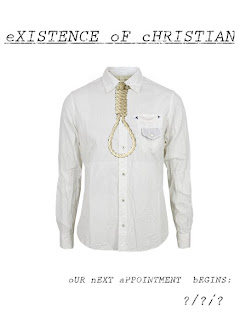
Ancilliry Task: Film Poster - First Draft

One of our group’s ancilliry tasks was todesign a film poster for our film. This is to be completed with a magazine review of our film after the film has been completed. The finished 1st draft looks blank at first glance, but initially the production towards this draft culminates all of the factors in which we want from our short film.
To begin with, the title of our film came after a long and thoughtful discussion with members ofthe group and others that we know. We got the existence part of the film as our film shows thefinal moments of our character, who is eventuallymurdered by the psychiatristin our film, but it is made out to look like suicide throughout the film. Then we want a very average name to contemplate the mood that we wished to create in our film, to which we decided on the name ‘Christian’. Coincidentally, one of the people that gave us the idea for this was a friend of our named ‘Christian’. The slight faded effect of the writing was inspired from the card that we used in the AS film opening ‘Allegiance’,as well as the fact that it represents the slowly declining mind of the main character
.
On top of the title, the tagline to go with the poster needed to alert audiences of the film’s release, but it also needs to be connected with the film in some way. Because of this, I decided to make the style of writing the same as the main title (the 1st letter in small case, the rest in capitals with white spray paint to give it a faded effect). Because the story involves a patient having meetings with his psychiatrist, I decided on ‘Our next appointment is…’ as clever intertextuality between the poster and the short film. My main inspiration for this style of writing was from the same sort of style use in the film ‘eXistenZ (1999, Dir. David Crohenberg)’. It creates as sort of mental feel to the poster, as well as reflects the psyche of the mind of the main character.
The picture on the front of the poster is the part of the poster in which audiences will look at and think ‘What is that about?’ Originally the image was going to solely consist of a white shirt and a black tie (because that is what the main character wears throughout the film). However, one group member (Taylor Gladwin) made it apparent that the poster was very bland and that nobody would take interest in the poster because there isn’t anything interesting to look at. This is when we decided to make the tie a noose instead. Not only is it something more interesting to look at, but it also makes the audience believe that the main character is suicidal (when he isn’t).

Hopefully, some of the ideas used in this poster will be incorporated into the final poster used to present our film to audiences. Otherwise, if we do decide this poster to use, the group can add things to the poster to make it more appealing to audiences. This I hope will give us a better chance of gaining a better grade in the ancilliry tasks.

Wednesday, 8 December 2010

Influences - Shaving Scene

In our short film, there is a shaving scene where Christian (the main character) cuts himself shaving in preparation for the day. The shot is then followed by rapid editing of Christian in the countryside in the rain. The implications of this are to convince the audience that Christian is insane, and has in fact committed suicide. The main influence for this scene is the short film ‘The Big Shave’ (1967, Dir. Martin Scorsese).


In the film we can clearly see that whoever is shaving in this film, though he may look fine to begin with, he begins to cut himself. At first we see nothing wrong, to which he eventually cuts himself so often, the audience watching this realise something is wrong with this person. This short film is a microcosm of the mentality of the Vietnam War. Basically, no matter how much damage this man does to himself he keeps going causing mass harm. Similarly, No matter how many people were sent in to be massacred in the Vietnam War, more and more kept on getting sent in.

This film is a huge influence to us for not only this scene, but the mental state of the character in Scorsese’s film is similar to our film, and this mental state continues throughout our film. Because of this, this film can also be considered as an influence for the mental state of the main character (Christian) as well. However, the main reason ‘The Big Shave’ was so helpful to us was for the shaving scene in ‘Existence of Christian’.

Tuesday, 23 November 2010

1st day Of Filming

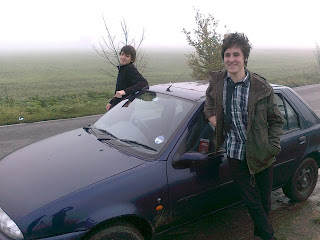
After the awful attempt to begin filming, we as agroup got our act together and decided that onFriday 19th November; we would spend the day filming for our short film. However, because we all had the same lesson first period, we all waiteduntil ten o’ clock to being shooting. So after confirming it was OK to go out shooting for the day, then signing out, we got into Dave Waters car and set off for our first day shooting.
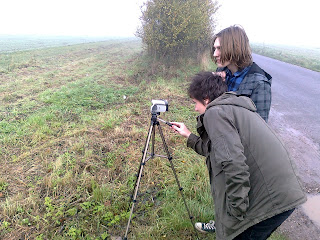

As we began driving to location, we decided what our primary and secondary objectives were to be for the day. Our primary objectives were to film shots of the country side for our opening title sequence. Our secondary objectives were to film parts of the film in which we could edit into the film. The main area of shooting would be in the Billericay country side roads (facing the fields) to represent the every slowly regressing psyche of the main character. The effectiveness of the shots use whilst we were in motion creates the effect of a journey within the mind of the main character.
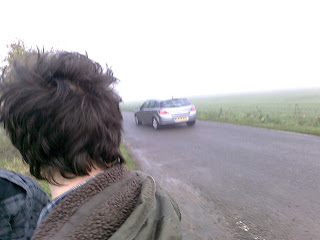
The most difficult part to shoot was the running in the mad scene. Due to the presence of the fog, it created a really nice effect of me disappearing into the distance. However, due to the wet morning conditions, the soil in which i had to run on was shift and difficult to run on. But after checking the footage out, it turned out to be worth the collateral damage, even though mud got everywhere.

The strengths of our first day made the footage look more towards the genre of which we wanted to create. The fact that we chose to film whilst the atmosphere was foggy gave an ominous feel to the video, as well create an amazing illusion when the main character runs into the distance. As well as this, the amount of footage we caught exceeded the amount which we may actually need for the scene we plan to create. Because of this, we have a large variety of choice when it comes to what can go in and out of the title sequence.

The weaknesses of this day, however, did make the day a little less productive as it could have been. For example, we did spend a lot of time driving around looking for locations because we hadn’t pre-planned the set location we planned to use. Also, half way through the day, we began to lack motivation for the task at hand, so we went to Dave Waters’ house in Billericay and began to distract ourselves by filming pointless footage and watching it back on the camera whilst. This not only wasted what little time we had that day to film, but it also crippled us in the sense that we could have used the time more productively (such as organise what we would do on another day of filming).


Overall, our first day of filming turned out differently than i personally had expected it to be. The shots we got were genuinely better than I had expected, but I feel a lot more could have been done to improve our future plans for this project. However, the next day shall further improve the project and get the grade we deserve as a group.

Thursday, 18 November 2010

Location Ideas

Setting and location is an important part of any film, and choosing the correct place to film can make or break the whole project. Our group has had many long discussions about where we feel the most productive location to film is. After we had our finished basic idea and had begun storyboarding, we had to decide how the particular location we would choose would affect the mood and tone of the film itself. To start with, we contemplated what the location should look like, before searching for somewhere that we already knew. For example, for the opening scene with the dead body in the bathtub, the group decided on what look we thought the bathroom should have, rather than choosing to settle on a bathroom in the home of one of the group members.

For the opening scene, we agreed that the bathroom and the bath itself had to be clinical. The body is calm, as if the prospect of death had lingered in the air for some time. To film this artistic death in an uninteresting, stereotypical family bathroom would have completely taken the impact away from this scene. Whoever the body is, this death has not been rushed and we wanted to give the bathroom the look of someone that is tidy and organised, and that his demise is just one of the things to tick off from his list of things to do on that day. A white bath with white tiles on the walls would be the perfect location for this scene. If there are any images on the walls, they may make the scene look amateur and lazy, depending on what the images are. This scene is probably the most important in our film and is our main controlling idea, so our group has decided to search thoroughly for the bathroom closest to the original ideas in our mind. In a perfect world, the bathroom would look similar to the one used in the film ‘Garden State’ (Dir. Zach Braff, 2004). At the beginning of the film, the character of Andrew ‘Large’ Largeman is heavily sedated and his whole house is very plain and clean. The walls are white, the bathroom is large and the bath itself is swallowed by the rest of the room. This use of setting was very cleverly chosen and gives the opening to the film the feeling of loneliness, but with a hint of OCD about cleanliness. The scene also has the look of purgatory, a big bland of nothing. If our scene looked similar to this, it would give the audience the feeling that the character already feels like he is on his way to death, and is just speeding up the inevitable.

Another important scene in our film is the discussion between the psychiatrist and the patient. This scene would require a psychiatrist’s office, but because we have no budget we must improvise. In our storyboard, the room is predominantly brown, with many books on shelves and a large desk. The two characters would be situated in the centre of the room in different chairs. The psychiatrist’s chair is small and comfy, making him look big and almost like a higher power. The patient’s chair is vastly different, huge and overbearing around him, making him look feeble and unimportant. This scene was well thought out throughout our group, but we realised that this location with the correct iconography would be almost impossible to find and use. Therefore, we decided that the specific chairs idea could be dropped if needed. We will continue to search for a similar-looking room. Any room that looks like it has been used daily for many years with many books or shelves could easily be seen as a psychiatrist’s office. A similar location to the one we are aiming for is in the film ‘There Will Be Blood’ (Dir. Paul Thomas Anderson, 2007). In a scene towards the end of the movie, Daniel Plainview is now very successful and living in a large house and his adopted son comes to visit him. Daniel is sitting behind a huge desk, and the room itself is also domineering and has a very arrogant feel to it. Shelves filled with books stagger the sides of the room and the walls are barely visible. A room similar to this is what we are aiming for. Of course, a room of that magnitude is most likely not going to be found by us to use, but if we could take specific elements from it our scene would come to life and be similar to the original ideas that we planned.

The title sequence is also an important scene to talk about in terms of location. The point of the title scene (apart from show our names) is to show the slowly diminishing mind of the main character. To portray this, the title sequence begins with a dolly shot of the beautiful countryside. After this shot, the images became more unattractive to the audience. The images and the main character’s mind are alike. The idea presented to us as a group was to film field and industrial based buildings as we were approaching location. The main mode of transport to get to these locations was by car (driven by Dave Waters). This then would get in the way of our shooting schedule, and it would be an extremely effective shot to use for the title sequence. One of our inspirations for this came from the Pink Floyd album ‘Animals’. The picture of just a factory and the smoke was the reason we decided to have the psyche decline in the title sequence by using images from the industrial world. The beginning of the title sequence where the beauty of nature is captured to imply sanity within the psyche of the main character is very important to capture correctly. Because of this, the location needed to be beautiful, open and easy to get to. We eventually decided to film the country side whilst within the car, to gain a really different dolly shot of the countryside. The idea for the countryside came from last year’s opening to a thriller ‘Allegiance’. The very first thing you see is the grass in a field, until the shot pans up and you see an unknown character being hanged from a tree. Instead of just the two seconds of just beauty, then shock, we plan to prolong the beauty and the depressing images to give the audience a chance to get into the mood of the film.

Overall, the locations we have chosen for our film have been chosen very specifically to allow the audience to feel the emotion we plan to emit from the scenes within our films. If the locations aren’t what we plan them to be like, our film won’t have the same emotion and it won’t be as effective. Based on this, location is very important to our project, and following the guide which we have set for our group would be very wise indeed.

Monday, 15 November 2010

Hypothesis for Questionnaire

For our questionnaire the group decided that it needed to be specific and bold if it was going to be any real use to us. We decided to build up a hypothesis of precisely what people we would ask. People outside of media studies don’t tend to watch short films, as they are hard to access and don’t have a large demographic to aim at. Because of this we decided to ask people outside of media studies so that we could gain an insight into what casual film watchers would look for or would interest them if short films were more easily available. By finding this out, it would also allow us to market our film better to casual film viewers outside of media and film production with posters and magazine reviews that have to be completed in the ancillary tasks.


From the answers we got it is clear to see that the majority of people would not watch a short film out of choice. If they did watch one, they would prefer to watch it in a cinema before the feature film. The most likely reason for this is that it wouldn’t require any extra effort from the viewer as they are already at the cinema, and also the film would likely be the same genre as the feature film. Most would also be willing to watch a short film on YouTube rather than TV, for example.

Of the thriller sub genres, it would seem that people would rather watch a psychological thriller than a horror. Perhaps this is due to the fact that the Horror genre has been worn-out to the extent where these thriller hybrids are becoming somewhat cliché and thereby dull. Therefore, one could argue that the more contemporary thriller enthusiast likes how the human mind works, incorporated within a narrative full of enigmas and twists.

However, from our questionnaire, we also formulated data which suggested that the conventional thriller fan prefers realist narratives opposed to surrealism. This would suggest that although perhaps the simplicity of the horror/thriller may be a dying breed, audiences still enjoy a simple narrative that can keep them engaged, yet perhaps with a twist that will not disrupt the flow of the narrative.

Overall, when looking back upon the early hypothesis devised by Taylor Gladwin, the questionnaire closely reflects his notions above (with some slight variations).However, from this piece of data collection, we can now modify our marketing strategies, and perhaps showcase our short before a feature film of the same genre. The audience would therefore feel inclined to watch our short as it would bear little or no effort to watch. We can also back-track to our storyboard, and slightly tweak the narrative to meet our demographic requirements.

Focus Group

Just like AS level, a focus group was conducted to gain a better understanding of what should be expected within our short film. But, unlike last year, the questions would be very different due to the fact that short films are not as popular as feature length films. Because of this, we needed to make sure that questions we asked didn't confuse the members of the focus group or create dis-illusion about what is expected of our short film. Though the group wasn't as big as expected, two of the three members were media students, and one student didn't study media. We felt that this would benifit the production better as someone with no real experience of short films would show more of what the majority of audiences want, not just what is told to the media students.

The questions were chosen as a group to keep conversation going within the group. Awkward silences would not only not benifit our research what so ever, but also the members of the focus group would feel less comfortable answering the questions. We had a first attempt at a focus group, and the questions were too specific, and the members of the focus group feel victim to the awkward silences. An example of these questions would be:

What is your favourite short film? and How many short films have you seen?

These questions don't promote a real answer as the majority of any group would say they haven't seen many short films (and won't remember what they were), and won't attempt to look for a short film for cheap 5 minute entertainment. To prevent this, we made the questions more broad to keep the group interested and provide better reseach material for our short film. This is why the questions had to be about films in general, and then we slowly moved into the category of short films, still not trying to make an awkward moment arise.

These were the questions we eventually came up with:

1) What is your favourite film (in general) and why?
2) What do you think makes a good film?
3) What characters do you best associate with within a film?
4) Where would you preferably watch a short film?
5) What would you like to see in our short film that would make you want to see it?

Those were the questions and this is how the focus group went:

Friday, 12 November 2010

Problems On Our First Day Of Filming

Friday 12th of November was supposed to have been the 1st day of filming for the group, but complications that arrived at the last minute have prevented this, thus, postponing filming. There we as a group decided to get filming as of this date and the problems mounted up one after another. These were the problem that we faced.

The first problem we faced was that one member of the group (David Huxford – myself) had an appointment for A&E scheduled on the day, so the group would most likely have to film without me. However, due to an early arrival at the A&E and the swiftness in which I had my foot checked, I managed to get back before 11 o’ clock; the time in which we all planned we would leave.

Even though all members of the group were planned to go filming now, another problem had risen from nowhere. Due to poor communication between each other, we all didn’t have a clear picture of what we were going to do once we had set off filming. But because of this, the group member that was going to drive us to locations wasn’t in at the time planned. Because he didn’t have a lesson until last, he didn’t feel sure that all of us were going to be at school and ready to go, so he weas still at home, presumably sleeping.

Fortunately, we will all be in together on Friday 12th November to re-schedule the day of our first day of filming, most probably to sometime next week. But this just shows that as a group, we haven’t learnt from our mistakes of last year. And being as we don’t have as much time as we had last year, we cannot postpone filming to a ridiculously late date, so we shall wait and see how this pans out.

Thursday, 4 November 2010

Final Storyboarded Idea


Even though our final idea did take considerably longer to complete than the other groups, we as a group finally managed to complete the storyboard explaining our idea. The story is as follows:

Brief Description of Action

Shot 1) Film opens with shot of plug socket. As non-digetic radio talking goes on, the camera pans across the room, following the plug. The plug eventually leads into the bathroom.

Shot 2) The non-digetic soundtrack makes the scene contrapuntal. We see a dead body face down in a bath full of water. The radio ends and the shot turns to black.

Shot 3) Extreme close-up of a body of water. Eventually, a drop of blood falls into the water to turn the water red. The camera slowly tracks up.

Shot 4) As the audience thinks death, it turns out to be a man who has cut himself shaving. A split mirror points out the split personality of the character. He stares at his reflection for many seconds.

Brief description of Action

Shot 5) Low angle shot of psychiatrist. Dialogue will be put into the scene. Psychiatrist makes himself far superior to the patient.

Shot 6) High angle shot of the patient. We feel sorry for the patient at this point, making himself rather inferior to the psychiatrist. The room’s colour will reflect the mood of the patient.

Shot 7) Shot of the country side, the dolly shot will go across the field and capture natures beauty, contrapuntal to the story line ( Possible title sequence to go here)

Shot 8) The patient is getting changed into his smart attire. There’s rapid editing at this point between shot 8 and shot 9.

Brief Description of Action

Shot 9)A clock on the counter is going anti-clockwise. Rapid editing between last shot at this point.

Shot 10) Main character beings to go crazy after the rapid editing. The mental psyche of main character begins to break here.

Shot 11) Wide shot of the main character sitting down, looking at his hands. The shot isolates the character as well as better continues the physical sign of his psyche failing.

Shot 12) Point of view shot towards the radio on the desk top. This is ment to be symbolic of the 1st shot and the radio used then.

Brief description of Action

Shot 13) Darkened out room and lamp motivate the psychiatrist to work. The psychiatrist is writing his notes. The darkness amplifies the idea of secrecy within his work.

Shot 14) Close up of the documents show that he is reviewing the main character.

Shot 15) Almost parallel to the psychiatrist, the main character, too, is writing. But instead of documents, he’s writing a note. Again, isolation is the key theme with this part.

Shot 16) Upon close up, we see what he has written. This is to imply that somehow the patient and the psychiatrist are connected.


Brief Description


17) The main character is told by his psychiatrist to close his eyes and breath as a different means of 'help'


18) However, something appears to be wrong. The main character faints as the psychiatrist puts on his coat.


19) To hide the body, the psychiatrist is seen taking the body up a flight of stairs to the bathroom.


20) As the psychiatrist leaves the crime scene in the bathroom, we see a note on the bathroom door saying 'Life is precious, but not to me.'


Brief description


21) After the suicide is revealed to be a murder, and the murderer walks away, the climax to the film is revealed.


22) End Credits.

Wednesday, 3 November 2010

Codes and Coventions of a Short Film/Trailer

The codes and conventions of short films are what make up the basis of short films throughout the world. The basic structure of a short film is quintessential for a short film to be a success. Even the short film we have witnessed within the lesson have followed the same codes and conventions as each other, Which means we as a group need to follow these codes and conventions to gain the best possible grade.

The codes and conventions of trailers are similar, but do differ in some areas. The main point of the trailer is to alert audiences of the film’s release, to gain as much popularity from audience as possible. Trailers wouldn’t normally be used for short films, simply because most short films are too short, and the trailer may reveal too much of the storyline.

On average, shorts films are between 2 minutes and 45 minutes. This is to include a long enough time period to include a relatively good storyline. Short films can be longer or shorter or longer than the average amount, but to keep interest in the audience for long enough, the films are usually between the 3 – 10 minute mark.

Trailers are a lot shorter. Due to the nature of a trailer, simply alerting audiences of the genre and release date, trailers are normally between 10 – 60 seconds. To prevent too much being revealed in terms of plot, actors and director are the only mention of what’s within the film. This attracts audiences rather well as good actors will normally invite audiences to watch the film, where as bad actors repel audiences.

Financing for both the short film and the trailer comes from different sources. Short films are usually a directors 1st major step in the world of cinema, so the director finances his films from their own pocket, to which he/she eventually gains institutional backing. Trailers are different, because they are usually a part of a film made and financed in Hollywood. Because of this, the financing of the trailer will be from Hollywood, so that the institution backing the production and the director can gain as big a profit as possible.

As well as this, short films quality is also affected. The number of cameras used is usually less than in a Hollywood film, the music is also found in sources where either the music is free or cheaply put together. Even the actors are found from unknown sources, usually found out to be friends of the director (to save money), whereas in a trailer, the music used is normally the soundtrack of the entire film, and the actors are well known throughout the world.

Overall, these codes and conventions will be followed whilst our film is in production, as financing for it shall come from our own pockets, as well as props and characters for the short film. A trailer won’t be used for advertisement because even though the film is 5 minutes long, we feel that the trailer may reveal too much of the storyline to the audience.